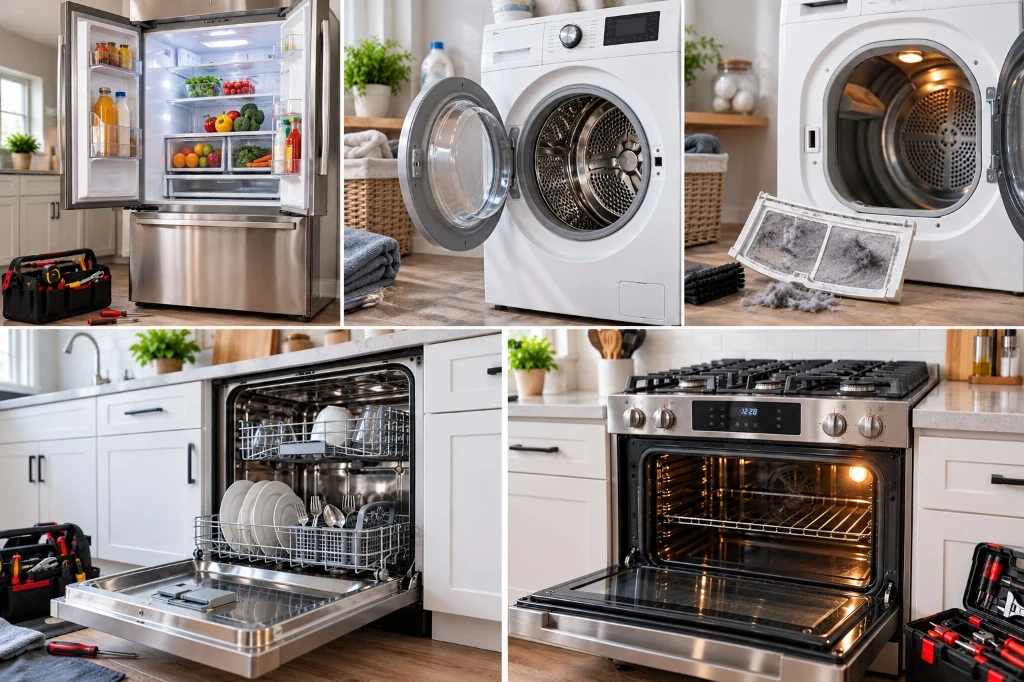

It is a familiar scenario in households across Toronto and the Greater Toronto Area: your seven-, eight-, or ten-year-old washing machine suddenly leaves a tub full of water, your refrigerator begins struggling to keep the produce drawer cold, or your clothes dryer tumbles without producing any heat.
Your immediate instinct is often anxiety: "Is this machine finally done? Should I just bite the bullet and buy a brand-new one this weekend, or will a repair cost half as much as a new unit anyway?"
Homeowners frequently assume that once an appliance crosses the seven-year mark, every operational hiccup is a sign of impending retirement. But in the experience of licensed field technicians, that assumption frequently leads families to spend thousands of dollars prematurely.
In this guide, we break down the real mathematics behind the Repair vs. Replace dilemma, how to apply the industry-standard 50% rule, the costly hidden expenses of replacing that retail stores never mention, and why getting an honest on-site diagnostic assessment is the single best move before making a final decision.
The 7–10 Year Appliance Crossroads: Why Homeowners Panic
When an appliance is two or three years old, deciding to repair it is a no-brainer. But once an appliance reaches seven to ten years of age, homeowners enter what technicians call the uncertainty zone.
The natural hesitation comes from two competing fears:
The fear that paying for a repair today will only buy a few weeks of life before another component breaks down, leaving you out of pocket twice.
The fear of rushing out to buy a new replacement when the existing unit only needed a straightforward, affordable part to run for another five years.
Major home appliance manufacturers and industry guidelines—such as benchmarks referenced by the Association of Home Appliance Manufacturers—generally estimate that core household appliances (like refrigerators, clothes dryers, and cooking ranges) have typical design lifespans between 10 and 15 years when properly maintained. Reaching the seven-year mark does not mean the appliance has exhausted its mechanical utility—it simply means routine wear-and-tear components may need professional attention.
The 50% Rule: A Practical Decision Framework
To remove emotion and panic from the decision, appliance professionals rely on a time-tested formula known as the 50% Rule:
The 50% Rule Formula:
If the repair costs less than 50% of a comparable new unit, repair it. Past 10 years with repeated repairs, lean towards replacing.
This keeps the decision straightforward: a single targeted component repair is almost always worth the investment. However, if an aging unit is well past the 10-year mark and experiencing repeated, compounding mechanical failures, replacement becomes the more sensible long-term path.
Here is how standard residential appliance lifespans break down under typical Ontario household usage:
| Appliance Type | Average Lifespan | At 7–10 Years Old | Recommended Action |
|---|---|---|---|
| Refrigerators | 11 – 15 years | Within operating lifespan | Repair if non-sealed system |
| Washing Machines | 10 – 13 years | Within serviceable lifespan | Repair pump, valve, or belt |
| Clothes Dryers | 12 – 16 years | Strong mechanical life remaining | Almost always repair element or fuse |
| Dishwashers | 9 – 12 years | Serviceable life stage | Repair seal, pump, or valve |
| Ovens & Stoves | 13 – 18 years | Prime operating lifespan | Almost always repair bake element or igniter |
Notice that across most appliance types, a 7- to 10-year-old machine is nowhere near the end of its operational life (with dishwashers being the primary exception as they approach their 9- to 12-year window). For refrigerators, clothes dryers, washers, and cooking ranges, many units are still operating well within their reliable service years.
Which Component Repairs Are Almost Always Worth Fixing?
Household appliances are modular systems. When a machine stops operating, it is rarely because the entire unit has broken down all at once. In most service calls, the failure is isolated to a single, replaceable wear-and-tear part.
Here are common component failures on 7–10 year old appliances that are almost always worth repairing:
Refrigerators: Start Relays, Defrost Sensors & Fan Motors High Value Repair
If your fridge compartment is warm but the compressor is still clicking, the culprit is frequently a simple compressor start relay, a defrost timer, or an evaporator fan motor. Replacing these parts costs a small fraction of a new refrigerator and restores precise cooling. Read our in-depth Toronto refrigerator repair cost guide or book our refrigerator repair service.
Washing Machines: Drain Pumps, Water Inlet Valves & Belts High Value Repair
A washer that refuses to drain, fill, or spin is usually dealing with a jammed drain pump impeller, a worn drive belt, or a faulty lid lock mechanism. These are straightforward mechanical swaps that can give your washer several more years of dependable service. Check our washing machine not draining guide and our dedicated washer repair service in Toronto.
Clothes Dryers: Thermal Cutoffs, Heating Elements & Rollers High Value Repair
Dryers are among the most mechanically straightforward appliances in your home. When an electric dryer spins without heat, the root cause is almost always a blown thermal safety fuse or an opened heating element coil. Replacing the element and clearing the exhaust vent restores factory heating performance. Learn more about our clothes dryer repair services.
Dishwashers: Circulation Pumps, Spray Arms & Door Gaskets High Value Repair
Minor leaks or gritty dishes are often caused by cracked door gaskets, mineral-clogged wash arms, or a stuck check valve. Replacing these accessible wear parts costs far less than a new built-in unit. Explore our dishwasher repair service.
Ovens & Stoves: Bake Elements, Surface Burners & Igniters High Value Repair
An electric bake element that burns out or a gas igniter that weakens over time is an inexpensive, fast fix. Range chassis are built of thick steel and can easily last 15 to 20 years with occasional element or sensor replacements. Learn about our oven and stove repair solutions.
The Diagnostic Advantage: Know the Exact Math Before You Decide
The biggest mistake homeowners make is guessing. They look at a leaking washer or a warm fridge, imagine the worst-case scenario, and spend thousands on a new appliance before they even know what was wrong.
The smart, low-risk approach is simple: get an exact diagnosis first.
Know the Exact Cost Before You Decide
Get an on-site diagnostic with your repair, and the diagnostic service call fee is completely waived when you go ahead.
Our certified technician conducts a thorough electrical and mechanical assessment of your appliance. We identify the root failure, show you the worn component, and provide a transparent, upfront written quote. When you approve the repair, the diagnostic service call fee is completely waived—you only pay for the repair itself. If the appliance is genuinely beyond economical repair, you receive honest, unbiased advice with zero pressure.
Every repair performed by Appliance Repair Knights is backed by our comprehensive written warranty on parts and labour using genuine, manufacturer-approved quality replacement parts.
Book an Honest On-Site Repair Assessment in Toronto & the GTA
Before you spend your hard-earned savings replacing an appliance that still has years of dependable life left, let a certified local technician give you the facts.
Appliance Repair Knights provides prompt residential dispatch across Toronto, Mississauga, Brampton, Vaughan, Markham, Richmond Hill, Oakville, Burlington, and surrounding GTA communities. Check our GTA service areas directory to confirm immediate coverage in your neighborhood.